

Landmark BMJ Study Into Dog-Related Injuries And Calls For Tougher Lead Laws
CWU has campaigned for numerous years on Dangerous Dogs legislation and partnered with University of Liverpool's Merseyside Dogs Partnership.
A new study, entitled “Using civil claim enquiry data to understand the context and impact of dog-related injuries in England and Wales between 2017 and 2024”, and led by Dr John Tulloch and Dr Gemma Ahearne of the University of Liverpool, alongside Jasmine Moxey-Butler and James McNally, who head Slee Blackwell’s specialist dog injury team; has been published by BMJ Journals and on the Lexology website.
 The study published under Copyright Clearance Centre’s RightsLink service, is available to download from the Unionsafety e-library here. Use Dangerous Dogs category to find the document.
 The interdisciplinary research, published online in Injury Prevention, analyses anonymised civil claim enquiry data to provide an unprecedented insight into how dog-related incidents occur across England and Wales, and what happens to victims afterwards.
Moving beyond hospital statistics
Unlike most published data on dog-related injuries, which rely heavily on NHS hospital admissions and emergency department coding, the new study uses solicitor enquiry data to capture the wider context of incidents — including where they occurred, whether dogs were restrained, and the long-term physical, psychological and financial consequences for victims.
Researchers analysed 842 civil claims arising from 816 dog-related incidents between 1 January 2017 and 31 March 2024. The vast majority (94%) occurred in England. While over 91% of cases involved dog bites, around 7% related to non-bite incidents such as dogs knocking people over — so-called “dog strikes”. The findings suggest that hospital datasets may understate both the scale and complexity of harm.
Dog strikes can be as serious as bites
Although bites accounted for most incidents — with 98% resulting in physical injury — non-bite cases were often severe. Around 73% of non-bite injuries involved fractures, with smaller numbers reporting tendon, ligament or soft tissue damage. Nearly one third of those injured in non-bite incidents required surgery, compared with around a quarter of bite victims. The authors argue that injury prevention strategies should treat dog strikes as a distinct and serious category of harm, rather than focusing solely on biting behaviour.
 Psychological trauma widespread
The study also highlights the often-overlooked psychological impact of dog-related incidents.
Psychological consequences were reported by 90% of bite victims and 76% of non-bite victims. In 15% of all cases, individuals received a formal psychiatric diagnosis linked to the incident, including specific phobia (6.5%) and post-traumatic stress disorder (4%). Researchers note that these are not short-lived reactions but clinically recognised psychiatric injuries, often persisting long after physical wounds have healed.
Public spaces and lack of restraint key risk factors
The data show many incidents occurred in everyday settings.
For bite cases, the most common locations were outside private residential properties (34%), on highways or pavements (18%), and inside private homes (11%). Nearly half (49%) of non-bite incidents occurred in public spaces, including parks, nature reserves and pavements.
In both bite and non-bite cases, most dogs were unrestrained at the time of the incident — 79% and 86% respectively. Most were reported to be with their owners.
The authors suggest this raises important questions about owner control and the adequacy of existing legal frameworks governing lead use in public spaces.
Delivery workers face elevated risk
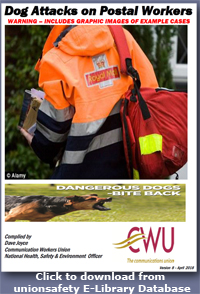
Delivery workers were found to be a particularly high-risk occupational group, accounting for 28% of bite victims. A common scenario involved an unrestrained dog emerging from a front door during a delivery. With online shopping now embedded in daily life, the study suggests this represents a predictable and preventable risk.
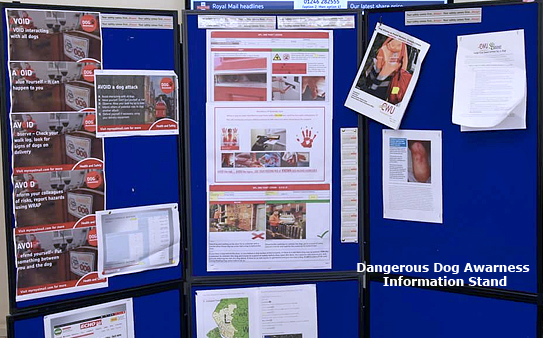
Part of CWU local Branch awareness campaign on Dangerous Dogs
Economic impact significant
Dog-related injuries also carried substantial financial consequences.
Among those in employment at the time of injury, nearly 60% of bite victims and 56% of non-bite victims took time off work, with reported absences lasting up to five years in extreme cases. Loss of earnings was reported by more than half of bite victims and over 40% of non-bite victims.
Calls to explore mandatory lead use
A policy briefing paper based on the findings has been submitted to inform future interventions, including consideration of mandatory fixed-length lead use — under two metres — on public highways and in urban green spaces, subject to designated off-lead areas.
The authors note that while the Highway Code advises keeping dogs on a short lead on pavements and shared paths, this guidance is not legally binding, and local authority enforcement through Public Space Protection Orders varies. They argue that clearer national expectations around control in public spaces may reduce preventable harm while balancing dog welfare considerations.

CWU's Dave Joyce campaigned for years
on dangerous dogs
A novel legal-academic collaboration
The study is believed to be the first to combine veterinary science, criminology and personal injury law using a solicitor database to examine dog-related injuries.
Researchers say civil claim enquiry data offers a richer understanding of incidents, capturing not only medical harm but also context, foreseeability, restraint, time off work and psychiatric injury — factors central to civil liability but often absent from healthcare datasets.
For Slee Blackwell, whose specialist team handles dog injury claims nationally, the collaboration reflects the growing recognition that the consequences of dog-related incidents frequently extend far beyond the initial physical injury.
The study concludes that dog-related harm is not limited to bites and is often life-changing. With a significant proportion of incidents involving unrestrained dogs in public or semi-public settings, the authors argue that prevention policy must now be informed by a fuller understanding of risk, impact and owner responsibility.
Editors Note:
 The CWU's Jamie McGovern has for several years been working with the University's Merseyside Dog Partnership both as an Area Safety Rep and now as a National H&S Policy Adviser to both the Postal and T&FS Constituencies of the Union.
He and the Merseyside Dog Safety Partnership worked for the introduction of service level agreements with Merseyside Police on tackling dangerous dog attack incidents, prosecuting bad owners and working on prevention of dog attacks by educating owners and potential victims of which too many are children.”
The Dogs trust is currently speaking with companies across the utilities and telecoms sector about dog bite prevention and potential formation of a new CWU Telecoms industry education partnership with the dog’s trust is in discussion.
Researchers from the dogs trust are acutely aware of the psychological impact and risks within the Telecoms industry from dog attacks and near misses inside homes and on properties.
Source: Jamie McGovern, CWU H&S Policy Adviser Central Serrvices / BMJ Journals / Lexology Website
